
Day 1 — Boolean Logic to Numbers: AND as min, OR as max
Binary rules meet graded truth so we can score fuzzy conditions with confidence.
Note: This article uses technical terms and abbreviations. For definitions, check out the Key Terms & Glossary page.
Introduction
Let's be real—business rules rarely fit neatly into crisp yes/no boxes. In any real-world pipeline, you're constantly dealing with "mostly true" or "somewhat satisfied" conditions. But if you just start throwing arbitrary weights around, you break the logical guarantees of your system.
Today we're upgrading classical Boolean Logic. We're going to let our truth values live anywhere in the continuous interval [0,1]. To keep our sanity (and the math intact), we need operators that behave exactly like AND and OR but respect this new graded reality.
The short version:
- Swap out AND for the Gödel t-norm
min(x,y)and OR for the Gödel t-conormmax(x,y). The laws of logic still hold up. - Graded truth lets us score heuristic rules smoothly. Most importantly, it's conservative: tightening a condition will never accidentally increase your score.
- These operators stay incredibly interpretable, support massive rule trees, and are basically the backbone of modern fuzzy logic systems.
About the 30-Day Series
I'm Sughosh P Dixit, Data Scientist at Oracle Finance. This is Day 1 of a 30-day series distilling the math and practical workflows I use every day. Expect:
- Foundational ideas explained with visuals and intuition.
- Real project ties from decision engines to monitoring.
- Hands-on examples and ready-to-use snippets.
Follow along, experiment, and share your takeaways—the goal is to build a robust toolkit together.
Why go beyond 0 or 1?
Think about how often rules have shades of gray. Two numeric conditions might be "mostly satisfied" rather than strictly true or false. When we move from the Boolean 1 to the real-valued [0,1], we unlock a few superpowers:
- Graded satisfaction: You can finally say "this rule is 0.7 satisfied".
- Smooth aggregation: Combining multiple conditions doesn't result in a harsh cutoff.
- Predictable behavior: If you tighten an input, the overall score won't unexpectedly jump up.
So, how do we actually generalize AND and OR for values between 0 and 1 without breaking the math?
T‑norms and T‑conorms (The Math Behind the Magic)
A t‑norm (T) is just a generalization of the logical AND to [0,1]. A t‑conorm (or s‑norm, S) generalizes the logical OR.
For these to actually work like AND/OR, we need them to follow a few ground rules:
For a t‑norm T (our AND):
- It doesn't matter what order you check things:
T(x,y) = T(y,x) - You can group them however you want:
T(x,T(y,z)) = T(T(x,y),z) - Increasing an input increases (or maintains) the output: if
x ≤ x′andy ≤ y′thenT(x,y) ≤ T(x′,y′) - 1 is neutral (ANDing with True changes nothing):
T(x,1) = x
For a t‑conorm S (our OR):
- Same rules for order, grouping, and increasing inputs.
- 0 is neutral (ORing with False changes nothing):
S(x,0) = x
Many pairs (T,S) exist. Today's focus is the Gödel pair:
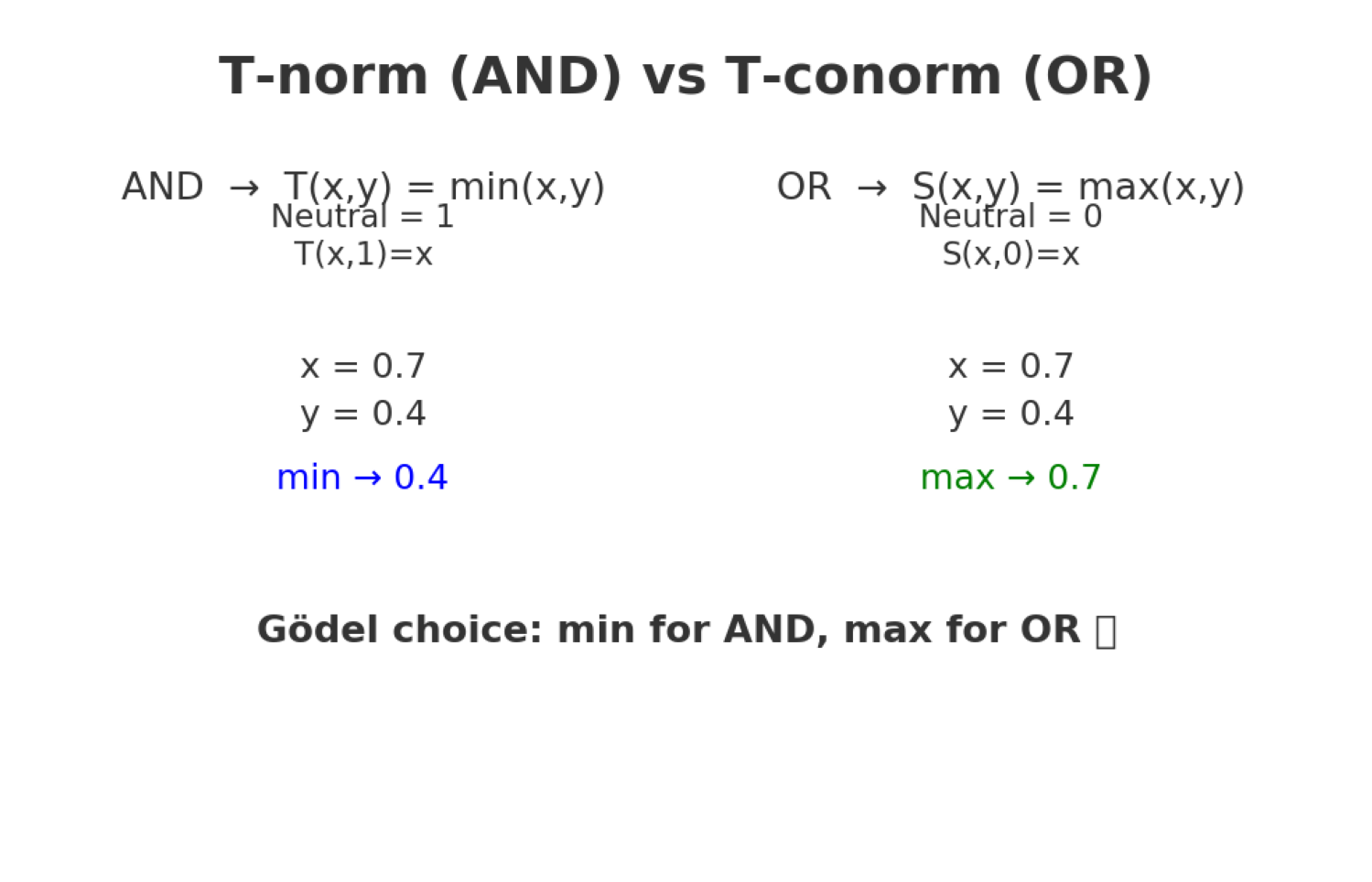
- Gödel t‑norm (AND):
T(x,y) = min(x,y) - Gödel t‑conorm (OR):
S(x,y) = max(x,y)
These are simple, conservative, and highly interpretable.
Gödel AND = min, OR = max
Define, for x,y ∈ [0,1]:
- AND:
x ∧ y := min(x,y) - OR:
x ∨ y := max(x,y)
Interpretation: the degree to which both conditions hold is limited by the weaker one; the degree to which at least one holds is governed by the stronger one.
Examples:
- AND: min(0.7, 0.4) = 0.4
- OR: max(0.7, 0.4) = 0.7
- Three inputs:
x ∧ y ∧ z = min(x,y,z);x ∨ y ∨ z = max(x,y,z)
Boundary behavior:
min(x,1) = x;max(x,0) = xmin(x,0) = 0;max(x,1) = 1
Idempotence:
min(x,x) = x;max(x,x) = x
Why this is a good generalization of logic
- If
x,y ∈ {0,1}, min/max reduce to classical AND/OR truth tables. - Monotonicity: increasing any input cannot decrease OR or increase AND.
- Conservatism: a weak conjunctive input (near 0) keeps the AND low, as desired.
- Interpretability: min/max are intuitive aggregators for "all conditions hold" / "at least one holds".
Quick proofs of key properties
Below, write T(x,y) = min(x,y) and S(x,y) = max(x,y). All x,y,z ∈ [0,1].
1. Commutativity
min(x,y) = min(y,x)
(symmetric definition), similarly for max.
2. Associativity
min(x, min(y,z)) = min(min(x,y), z)
Because min is the least element among {x,y,z}, either side is the minimum of the set. Same for max.
3. Monotonicity
If x ≤ x′ and y ≤ y′, then min(x,y) ≤ min(x′,y′).
Proof: The minimum cannot increase more than the larger pairwise components; similarly for max.
4. Neutral elements
min(x,1) = x
(1 never lowers a minimum)
max(x,0) = x
(0 never lifts a maximum)
5. Absorption
min(x, max(x,y)) = x
max(x, min(x,y)) = x
(x always "absorbs" itself.)
6. Distributivity (over each other)
On a totally ordered set like the reals in [0,1], min and max distribute over each other:
min(x, max(y,z)) = max(min(x,y), min(x,z))
max(x, min(y,z)) = min(max(x,y), max(x,z))
These are classic lattice identities for totally ordered sets.
Note on "counterexamples": min and max do distribute over each other on a total order. Distributivity fails if you mix different t‑norms/t‑conorms (e.g., product t‑norm with max). See the exercises for a concrete counterexample in that setting.
Visual intuition
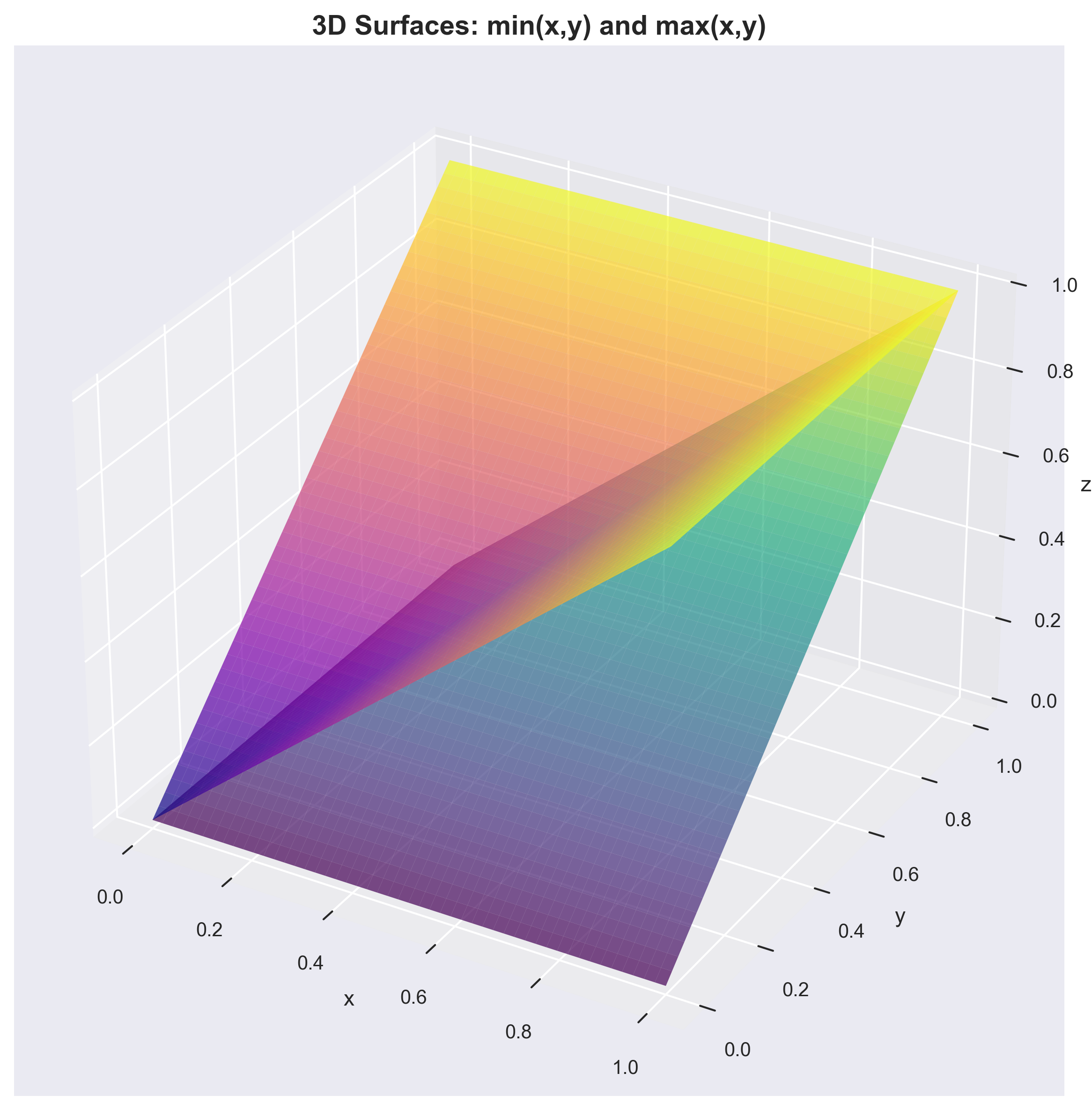
- 3D surface of
f(x,y)=min(x,y): a saddle‑like surface that follows the lower of the two planesz=xandz=y. - 3D surface of
g(x,y)=max(x,y): the mirror image that follows the higher ofz=xandz=y. - Color maps (
xon horizontal,yon vertical): min is dark (low) whenever either axis is low; max is bright (high) whenever either axis is high.
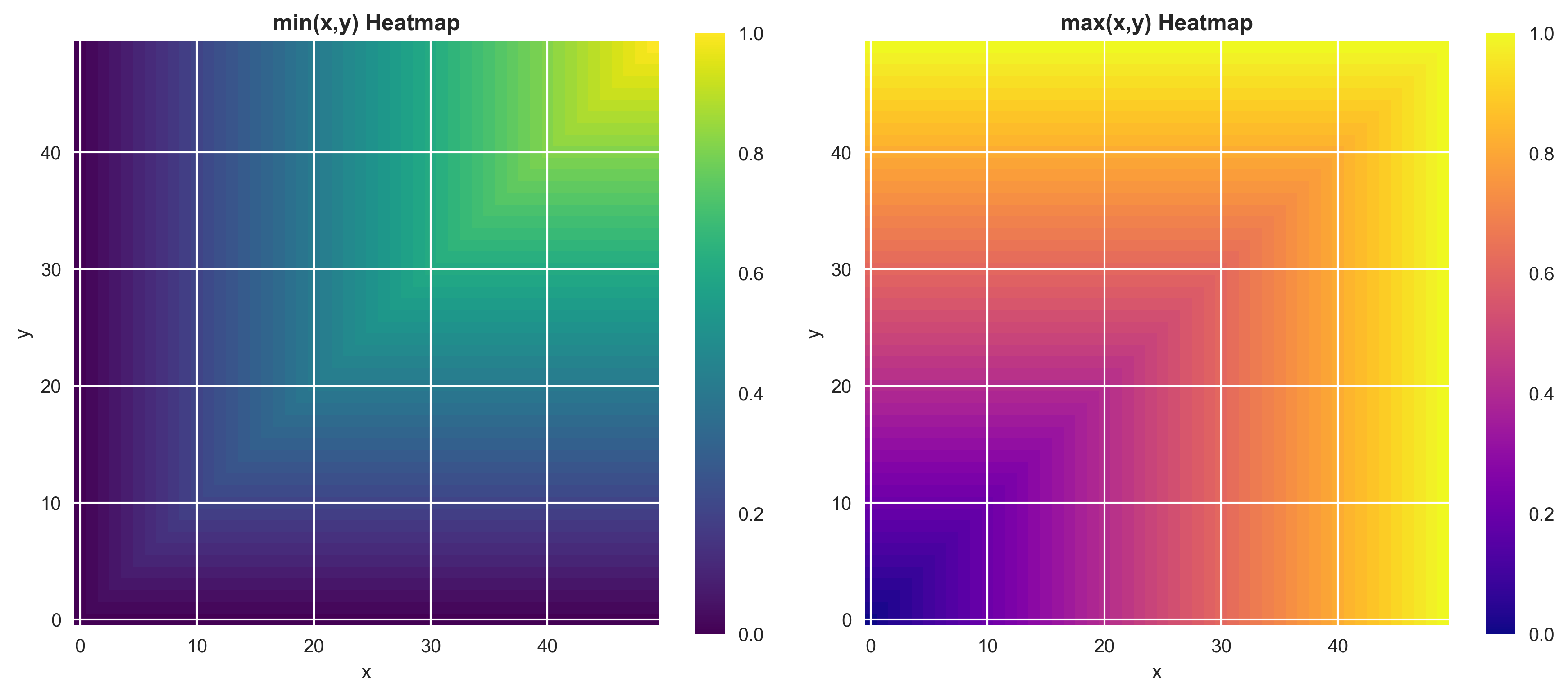
These visuals reinforce how AND is bottlenecked by the weakest input, and OR is lifted by the strongest.
Visualizing complex concepts makes them click!
Worked examples
1. Two‑feature rule: "(A AND B) OR C"
Using min/max: max(min(A,B), C)
Example 1: If A=0.6, B=0.8, C=0.55
min(A,B)= 0.6- OR with C:
max(0.6, 0.55)= 0.6
Example 2: If A=0.6, B=0.2, C=0.55
min(A,B)= 0.2- OR with C:
max(0.2, 0.55)= 0.55
2. Three‑way conjunction: "A AND B AND C"
Using: min(A,B,C)
- Case 1: (0.7, 0.65, 0.9) → 0.65
- Case 2: (0.7, 0.65, 0.1) → 0.1 (the weakest link dominates!)
The key insight: AND is bottlenecked by the weakest input; OR is lifted by the strongest input.
Bringing it back to reality: Rule Evaluation
When you're writing a rule expression in your code (e.g., feature1 AND (feature2 OR feature3)), swapping to this numeric approach lets you evaluate it directly on scaled inputs.
Interpreting AND as min and OR as max means:
- It's safe: Tightening a threshold won't falsely inflate the rule score.
- It's obvious: The final score is always bottlenecked by the weakest AND condition, and supported by the strongest OR condition.
- It scales: Nested AND/OR logic just becomes nested min/max functions, which are associative and incredibly cheap to compute.
Basically, you're turning "logical structure" into "min/max algebra," which lets you score complex rules consistently on real data without losing your mind.
Common alternatives (and why we started with min/max)
Other popular t‑norms and t‑conorms:
- Product t‑norm:
T(x,y)=x·y; Probabilistic sum t‑conorm:S(x,y)=x+y−xy - Łukasiewicz t‑norm:
T(x,y)=max(0, x+y−1); t‑conorm:S(x,y)=min(1, x+y)
These can be smoother or more conservative/aggressive, but min/max are idempotent (T(x,x)=x), preserve ordering cleanly, and exactly recover Boolean logic on 1. They're a standard, robust starting point.
Exercises
1. Prove the basics
- Show that min and max satisfy commutativity, associativity, and monotonicity on [0,1].
- Show identity elements:
min(x,1)=xandmax(x,0)=x. - Show absorption:
min(x, max(x,y)) = xandmax(x, min(x,y)) = x.
Hints: Use case splits (x≤y vs y≤x) and the definition of min/max.
2. Distributivity in a total order
- Prove that for all
x,y,z,
min(x, max(y,z)) = max(min(x,y), min(x,z))
max(x, min(y,z)) = min(max(x,y), max(x,z))
Hint: Reduce to sorted triples or use lattice theory for totally ordered sets.
3. A counterexample for mixed operators (bonus)
- Show that product t‑norm does not distribute over max. Find
x,y,z ∈ [0,1]such that
x·max(y,z) ≠ max(x·y, x·z)
Example: take x=0.6, y=0.2, z=0.9.
- Left:
0.6·max(0.2,0.9)=0.6·0.9=0.54 - Right:
max(0.6·0.2, 0.6·0.9)=max(0.12, 0.54)=0.54(this one happens to tie; tryx=0.3,y=0.9,z=0.4)
Try several triplets until you find strict inequality; in general the equality need not hold.
4. Interpreting outputs Given A=0.7, B=0.3, C=0.6, compute the rule score for "(A AND B) OR C" under:
Compare and discuss the differences.
The Takeaway
Replacing AND with min and OR with max isn't just a neat trick—it gives us a mathematically bulletproof way to score rule satisfaction on real, messy data. It preserves the essential laws of logic, keeps everything monotonic, and is actually easy to explain to stakeholders. It's the perfect foundation for building more sophisticated, quantitative rule systems (which we'll be diving into over the rest of this series).
References
-
Klement, E. P., Mesiar, R., & Pap, E. (2013). Triangular Norms. Springer Science & Business Media.
-
Hájek, P. (2013). Metamathematics of Fuzzy Logic (Vol. 4). Springer Science & Business Media.
-
Klir, G. J., & Yuan, B. (1995). Fuzzy Sets and Fuzzy Logic: Theory and Applications. Prentice Hall.
-
Zadeh, L. A. (1965). Fuzzy sets. Information and Control, 8(3), 338-353.
-
Gödel, K. (1932). Zum intuitionistischen Aussagenkalkül. Anzeiger der Akademie der Wissenschaften in Wien, 69, 65-66.
-
Dubois, D., & Prade, H. (1980). Fuzzy Sets and Systems: Theory and Applications. Academic Press.
-
Schweizer, B., & Sklar, A. (1983). Probabilistic Metric Spaces. North-Holland.
-
Fodor, J., & Roubens, M. (1994). Fuzzy Preference Modelling and Multicriteria Decision Support. Springer Science & Business Media.
-
Yager, R. R. (1980). On a general class of fuzzy connectives. Fuzzy Sets and Systems, 4(3), 235-242.
-
Nguyen, H. T., & Walker, E. A. (2006). A First Course in Fuzzy Logic (3rd ed.). Chapman and Hall/CRC.